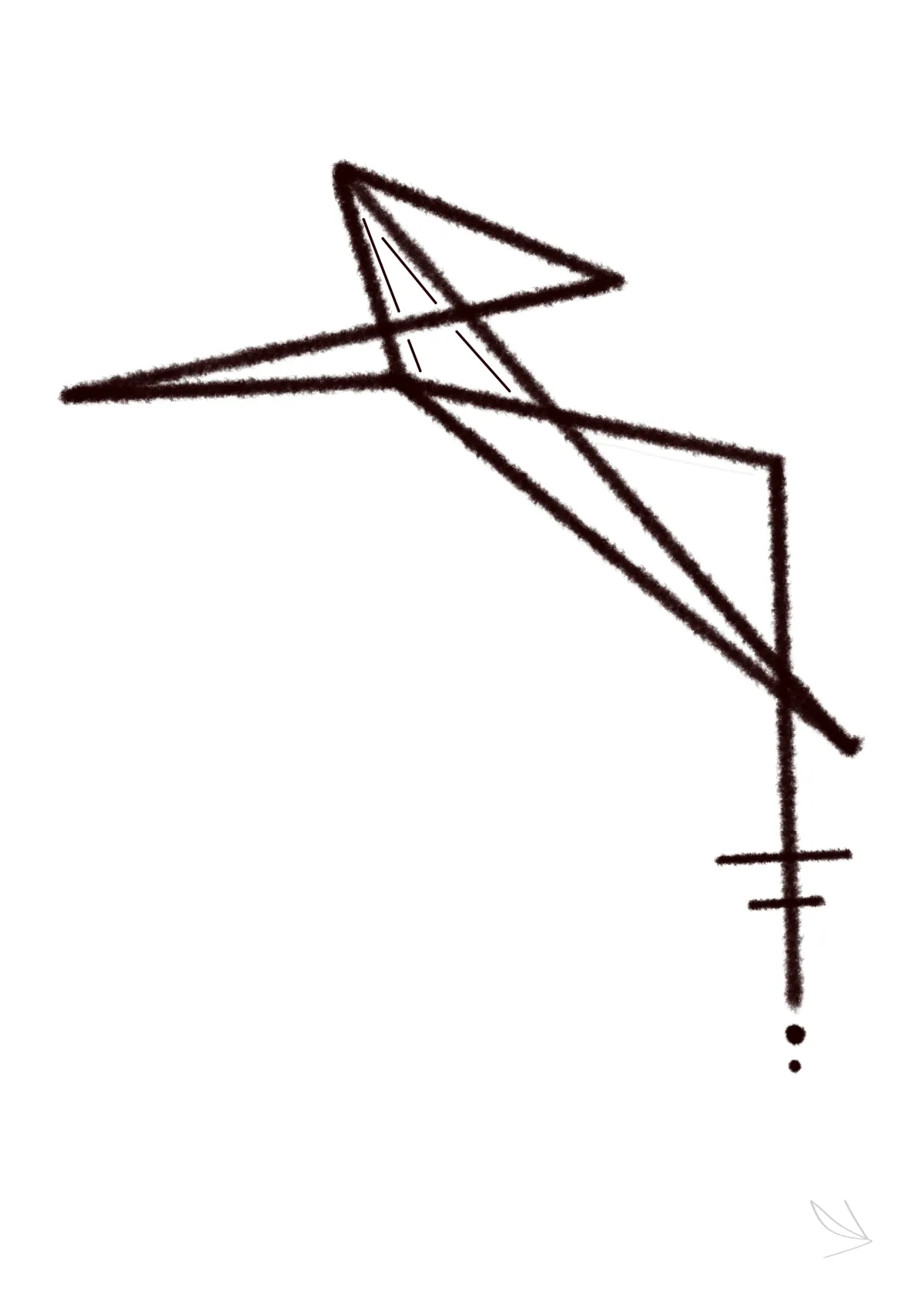
Can Symbols Influence the Way We Think?
Can Symbols Influence the Way We Think?
It's a question I get asked from time to time, and my answer is probably not what people expect.
I don't believe a symbol can make you think a certain way.
Instead, I believe a symbol can remind you of something you've already decided is important.
There's a subtle but important difference.
Take a simple word likechips. Most of us picture exactly that: chips. Maybe fried, salted, wrapped up from the chip shop or served alongside fish.
But imagine a symbol that represents chips instead.
For one person it might bring to mind potato fields, family dinners, ketchup, burgers, Friday nights, comfort food or childhood memories. For someone else it might mean completely different things.
A symbol doesn't tell you what to think.
It creates space for your own experiences, memories and associations.
That's what I love about symbolic design.
Two people can look at exactly the same symbol and see something slightly different. There might be overlaps, but there doesn't have to be. Neither person is right or wrong. The meaning belongs to the person looking at it.
Why I find that so powerful
Before becoming a symbolic designer, I spent several years working as a life coach.
One idea that always fascinated me was the Reticular Activating System (RAS). It's the part of the brain that helps filter the huge amount of information we're exposed to every day, making us more likely to notice the things we've already decided are important.
It's why, after buying a new car, you suddenly seem to see that model everywhere.
The cars were always there.
Your attention simply changed.
That idea had a huge influence on the direction my work eventually took.
I realised that symbols could become visual reminders of the intentions we choose for ourselves. Not because they possess magical powers, but because we naturally pay attention to the things we repeatedly attach meaning to.
That's why one of my first products was a collection of phone wallpapers.
Think about how many times you unlock your phone every day.
Every glance is an opportunity to reconnect with an intention you've already chosen, whether that's confidence, calm, protection or self-love.
The symbol isn't doing the work for you.
It's simply bringing your intention back into your awareness.
Where symbolism meets creativity
I've always been fascinated by sigils and symbolic traditions.
As I learned more, I discovered there are many different approaches to creating them, including chaos magic, witches' wheels and kameas (magic squares).
Out of respect for those traditions, I don't claim that there's only one correct method.
Instead, I draw inspiration from several approaches while developing my own creative process.
For me, intention is always the starting point.
From there, I sketch, experiment with geometry, simplify shapes and refine the design until it feels balanced. Sometimes that means following a traditional method closely. Other times it means trusting my instinct and making artistic decisions that create something both meaningful and visually simple.
Every symbol is created by hand, guided by the intention behind it rather than generated from a formula.
More than a picture
The symbols I create aren't designed to tell you what to think.
They're designed to help you remember what already matters to you.
That's what makes them personal.
Your associations will never be exactly the same as mine, and I think that's the beauty of symbolic design.
A symbol doesn't need to contain every answer.
Sometimes all it needs to do is quietly remind you of the intention you've already chosen to carry with you.