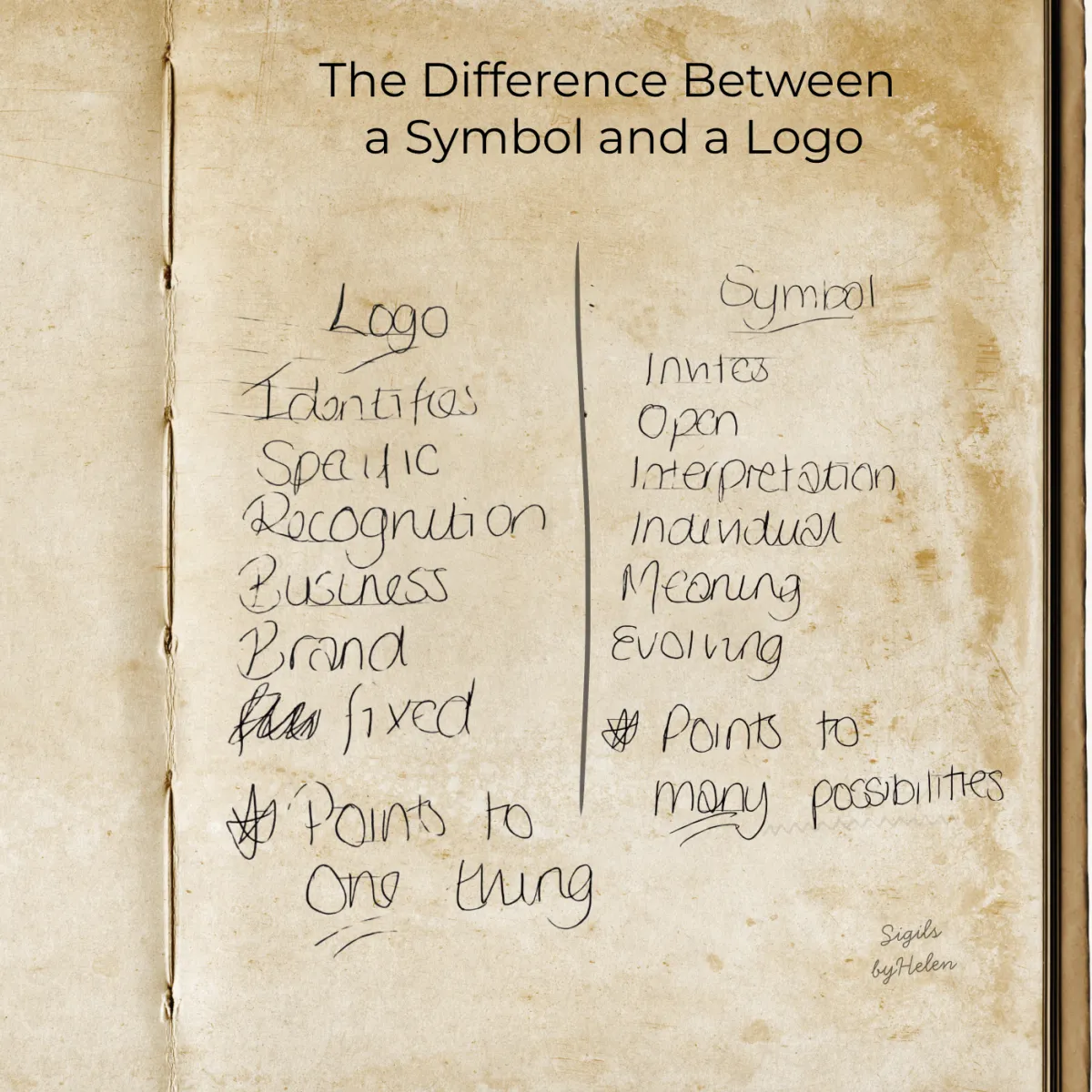
The Difference Between a Symbol and a Logo
There was a time when I would have used the words symbol and logo almost interchangeably.
After all, they're both visual marks.
They're both designed with intention.
They're both made to communicate something.
But the more I began designing symbols, the more I realised they serve very different purposes.
A logo is designed to identify.
It represents a particular business, organisation or person. Its job is to help you instantly recognise who something belongs to.
When you see a familiar logo, you don't usually stop to interpret it.
You think about the company behind it, their products, their services or your previous experiences with them.
It's specific.
Focused.
Purposeful.
A symbol feels different.
A symbol still represents something, but it leaves room for interpretation.
Instead of directing your thoughts towards one specific answer, it invites them to wander.
One of the ways I explain this is with a simple example.
If I say the word tomato, you'll probably picture a tomato.
If I show you a picture of one, you'll recognise it instantly.
But you might also think about growing tomatoes in the garden.
Someone else might think of ketchup.
Another person might remember making soup with their grandmother.
Someone else might picture a cheese and tomato sandwich.
We all arrive at the same starting point, but the journey our minds take is different.
That's what symbols remind me of.
They create space for memories, experiences and personal meaning.
The destination may be similar, but the route is unique to each individual.
That's why I don't believe the meaning of a symbol should be rigidly defined.
When I create a symbol called Protection, for example, the word protection is simply the intention I use during the design process.
It's the starting point.
For one person, that symbol may become a reminder to protect their peace.
For someone else, it might represent emotional boundaries.
Another person may associate it with feeling physically safe.
None of those interpretations are wrong.
The intention remains the same, but the meaning grows through the experiences of the person using it.
That's also why I don't feel it's my job to define exactly what a symbol should mean to someone.
My role is to create it with intention.
I hope it encourages positive action, but I don't decide what that action looks like.
Only the person using it can do that.
People sometimes ask whether I can create a logo.
The answer is yes.
When I design a symbolic logo, I still use the same intentional process I use for my other symbols.
I work with the client's business commencement date, a single word that captures the heart of their business, and a planetary magic square to guide the geometry.
The result is still a symbol.
It's simply being used as the visual identity of that particular business.
In that context, it becomes both a symbol and a logo.
Its purpose is more specific, but its creation remains deeply intentional.
For me, that's the real difference.
A logo identifies a business and communicates its vision.
A symbol invites personal interpretation and encourages positive action.
One tells you what something is.
The other quietly asks what it could mean to you.
And perhaps that's why I've always been drawn to symbols.
They don't tell us what to think.
They simply offer a place to begin.