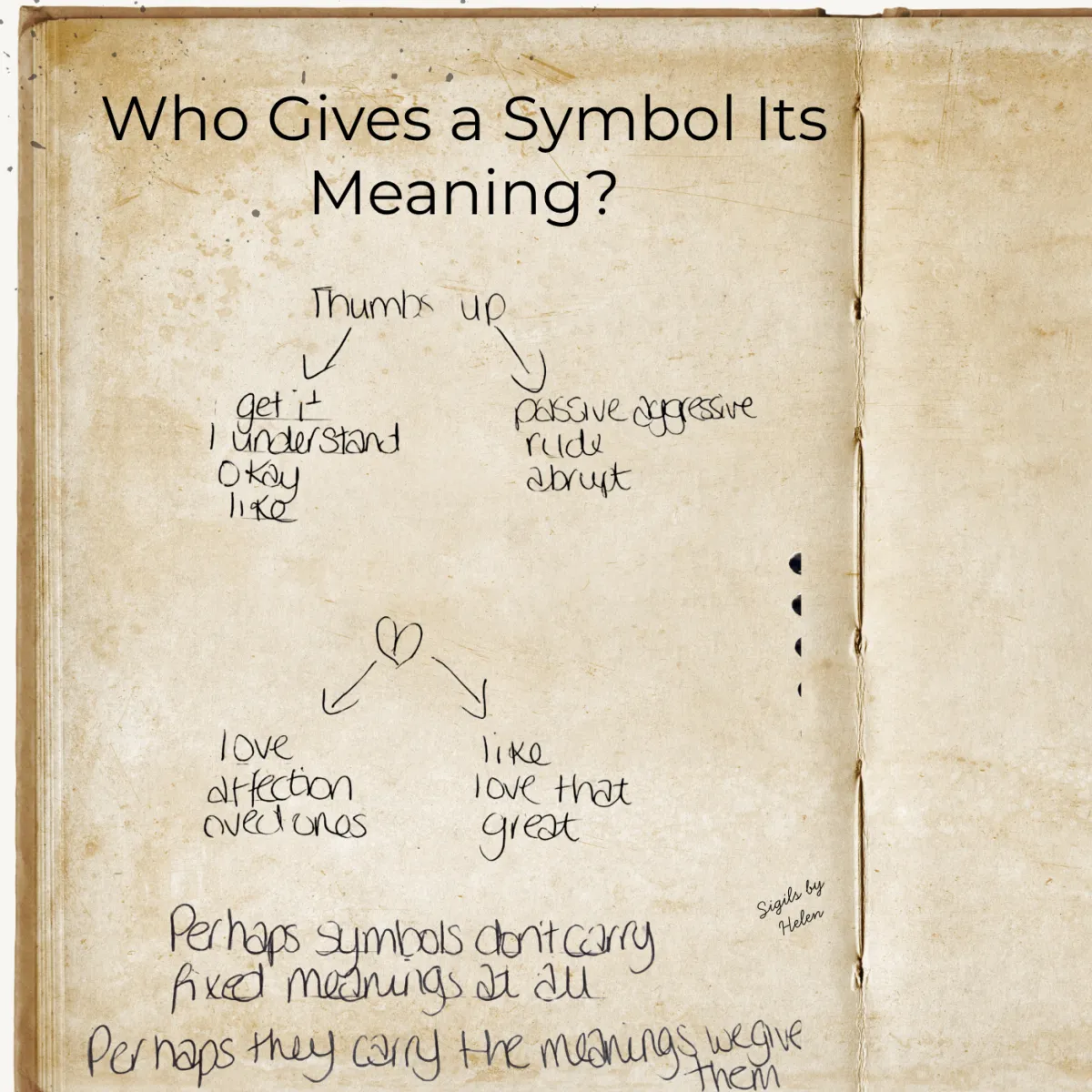
Who Gives a Symbol Its Meaning?
Have you ever noticed that not everyone interprets the same symbol in the same way?
It's something I've been thinking about a lot recently.
It started with something surprisingly ordinary.
A smiley face.
I almost always choose the smiley emoji with rosy cheeks.
To me, it feels softer.
Kinder.
More genuine.
It's a tiny difference, but it changes how the message feels.
Someone else might never notice.
Someone else might prefer a completely different one.
That made me wonder...
Who decides what a symbol means?
A while ago, I was reading Happy by Derren Brown.
Near the beginning of the book, he talks about how adding a simple smiley face to a message can completely change how we interpret it.
The words themselves haven't changed.
The symbol has.
A sentence that might otherwise feel blunt or critical can suddenly seem warmer, more understanding or even apologetic.
It isn't because the smiley changes the words.
It changes how we experience them.
That really stayed with me.
It also reminded me of my own experiences.
Years ago, I worked in an environment where I was bullied.
Because of that, I became incredibly careful with how I communicated.
I'd often add a smiley face or another emoji to messages simply to reassure people that my words came from a place of kindness.
The emoji wasn't there to decorate the message.
It was there to communicate something my words couldn't quite achieve on their own.
Not everyone would have interpreted those symbols the same way.
But to me, they mattered.
Then I started thinking about another emoji.
The thumbs-up.
For most of my life, I've understood 👍 to mean something positive.
"I've seen your message."
"I agree."
"Thanks."
"That's great."
Yet I've read that many younger people interpret it very differently.
To some, it can feel abrupt, dismissive or even passive-aggressive.
I find that fascinating.
The symbol hasn't changed.
We have.
Our experiences change.
Our cultures change.
Our relationships change.
The meaning we attach to symbols changes too.
I noticed something similar with the heart emoji.
To me, ❤️ has always represented love or deep affection.
So I naturally reserve it for people I'm close to.
Then I joined a group chat where everyone used the heart simply to acknowledge messages.
Nobody discussed it.
Nobody decided that was what it meant.
Over time, I found myself using it in exactly the same way.
The symbol hadn't changed.
My understanding of it had.
Perhaps that's true of far more symbols than we realise.
A wedding ring might represent lifelong commitment to one person.
To someone else, it might remind them of loss.
A tattoo can hold an entire lifetime of memories for the person wearing it, while everyone else simply sees an interesting design.
Even the symbols I create are no different.
I might create a symbol using the word Protection.
One person might wear it as a reminder to protect their peace.
Someone else may think about healthy boundaries.
Another person may associate it with feeling physically safe.
The intention is shared.
The meaning is personal.
That's why I don't believe it's my job to tell people exactly what one of my symbols should mean.
My role is to create it with intention.
The person using it completes the story.
Perhaps that's why symbols have remained with us for thousands of years.
Not because they all carry one fixed meaning.
But because they quietly adapt to the lives of the people who use them.
Maybe that's their greatest strength.
They don't tell us what to think.
They give us somewhere to begin.
Because perhaps symbols don't carry fixed meanings at all.
Perhaps they carry the meanings we give them.