Why Have We Always Used Symbols?
Have you ever wondered why human beings have always created symbols?
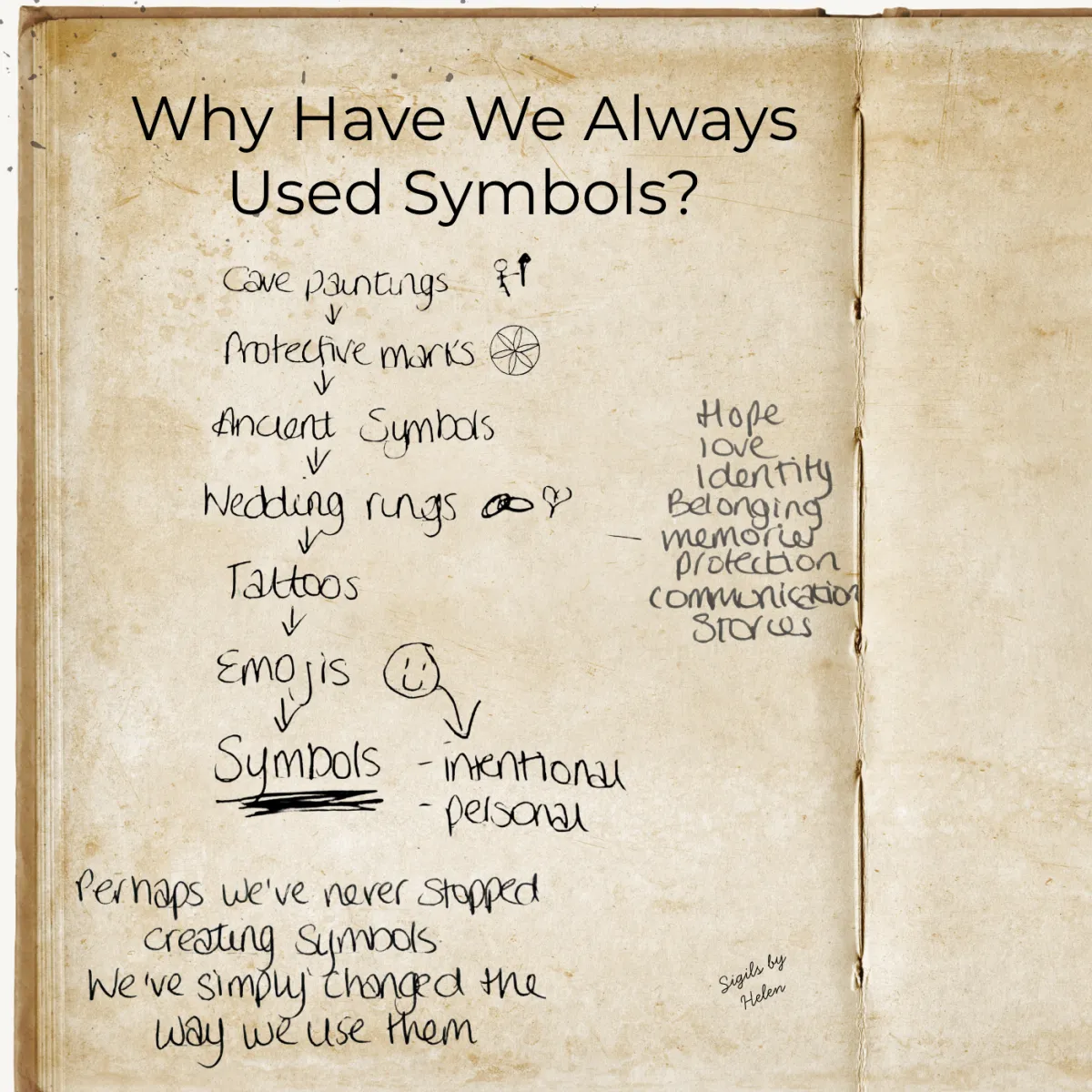
Long before most people could read or write, they were carving marks into stone, painting stories on cave walls and leaving symbols behind for others to find.
Even centuries later, people continued carving protective marks into churches, homes and everyday objects.
Language evolved.
Writing became more sophisticated.
Yet symbols never disappeared.
Why?
I don't think it's simply because they were useful before written language.
I think they do something words can never quite achieve.
Words are incredibly powerful.
They help us describe the world.
But sometimes there are experiences that feel bigger than language.
Imagine seeing something you've never seen before.
Something so unfamiliar that there isn't even a word for it.
Would you instinctively start describing it?
Or would you draw it?
Pictures have always helped us communicate the difficult, the emotional and sometimes even the unexplainable.
Perhaps that's why symbols have remained with us for thousands of years.
They don't replace language.
They work alongside it.
But they invite us somewhere words often don't.
We often think of symbols as something ancient.
Cave paintings.
Stone carvings.
Protective marks.
But perhaps we've never stopped creating symbols.
We've simply changed the way we use them.
Today we live in one of the most visually connected societies in history. We scroll through photographs, videos, icons and emojis every day, often understanding them long before we stop to read the words around them.
Instagram.
Pinterest.
TikTok.
YouTube.
Even our text messages are filled with emojis.
We don't seem to be moving away from visual communication. If anything, we're relying on it more than ever.
That makes me wonder...
Is it simply because pictures are quicker?
Or is it because something visual connects with us in a way words sometimes can't?
Perhaps that's why photographs can instantly transport us back to a memory.
Why a tattoo can represent an entire chapter of someone's life.
Why a single symbol can hold years of hopes, experiences and emotions.
Maybe we've never stopped thinking symbolically.
We've just found new ways of expressing it.
As children, we naturally imagine.
We invent worlds.
We tell stories.
We see possibilities everywhere.
As adults, we often become more focused on finding the "right" answer.
Symbols quietly give us permission to become curious again.
During my time as a coach and hypnotherapist, I often worked with symbols in a very practical way.
During a session, we'd create a symbol that represented the client's vision of success.
Together we'd explore everything connected to that vision.
What did success look like?
What did it sound like?
What did it smell like?
How did it feel?
What emotions came with it?
By the end of that session, the symbol had become connected to all of those experiences.
From that point onwards, every time they thought about the symbol, it naturally brought those feelings back to mind.
One symbol.
A whole collection of emotions, memories and ambitions.
Our brains are remarkably good at building those connections.
That's one of the reasons I believe symbols can become such powerful reminders.
Not because the symbol contains magic.
But because our minds naturally build meaning around it.
I think that's why I love tattoos so much too.
Many people simply see the artwork.
I see chapters of my life.
Every tattoo I have reminds me of something different.
Someone else might admire the design without ever knowing the story behind it.
And that's okay.
The meaning belongs to me.
Perhaps that's true of all meaningful symbols.
Their value isn't found in the lines themselves.
It's found in everything we bring to them.
That's also why I create symbols the way I do.
When someone wears one of my designs, I don't hope they simply think,
"That's the protection symbol."
I hope they remember their own strength.
I hope they remember their worth.
I hope pulling on a hoodie or T-shirt feels a little like putting on armour before facing the day.
Not because the fabric changes anything.
But because it reminds them of the intention they've already chosen.
The symbol doesn't create the courage.
It reminds them that the courage was already there.
Perhaps that's why symbols have never disappeared.
Some ideas are simply too big to fit inside words.
Symbols give us another way to carry them.